
Joint Mobilization in Lake Forest
You have stretched it for months and it has not budged, which is usually the clue that the muscle was never the thing holding you back.
What causes a joint to stop gliding?
Joint mobilization is a technique rather than a condition, and it sits inside manual therapy as one of the tools your therapist can reach for. Here is the idea it rests on. Every joint does two things at once: the movement you can see, like a knee bending, and a smaller sliding and rolling between the surfaces that you cannot produce on purpose, however hard you stretch. When that hidden glide is restricted, the visible movement runs out early and often hurts at the end. Stretching pulls on muscle. Mobilization addresses the glide itself, which is why one succeeds where the other has been failing.

Joint capsules tighten fast when a joint is held still. A spell in a cast, an arm kept in a sling after surgery, an ankle you protected after a bad sprain: the tissue settles at the length it is being kept at. You come out of it able to move the limb, just not through the whole range, and the block feels like a wall rather than a stretch. That is the classic case for mobilization.
Frozen shoulder is the best known example, where the capsule thickens and contracts and the shoulder loses rotation in a recognisable order, often without an injury to blame. It is stubborn, it runs in stages, and it does not respond to being forced. Gentle graded mobilization is one of the few things that helps in the painful early stage, and firmer work becomes useful later once the pain settles.
An arthritic hip or knee usually loses its accessory glide as well as its obvious range, so the joint runs out of movement earlier than it should. Mobilization will not change what is on the scan, and it is not a treatment for osteoarthritis in its own right. What it does is buy back enough comfortable range for the strengthening work that actually changes how the joint copes.
Ligaments and capsules repair with tissue that is less organised than the original and often a little tighter. Years later the joint copes with daily life but hits a hard end point in one direction. Ankles after repeated sprains are the usual suspects, and restoring that one missing direction often unlocks a movement you had written off.
The spine is a stack of small joints, and they do not all move equally. When two or three segments stiffen, the ones above and below take more motion than they should and tend to become the painful ones. A therapist can feel which level is not contributing and mobilize that specific level, rather than stretching the whole region and hoping.
Sometimes nothing structural is restricting anything. The nervous system has decided the joint needs protecting and the surrounding muscle is holding it still. That kind of restriction eases with slow, rhythmic, low grade mobilization, which is more a conversation with the nervous system than a mechanical stretch. It is also why range can improve within one session, well before any tissue has had time to change.

How physical therapy in Lake Forest helps.
Mobilization is graded, and the grade is a decision your therapist makes about you on that day. The low grades are small, slow, rhythmic movements near the start of the range, chosen when pain is the limit: a gentle rocking meant to settle a joint, not stretch it. The higher grades are larger movements taken to the point where the joint resists, chosen when stiffness is the limiting factor: those feel like firm pressure and a stretch you can locate precisely. None of it is a thrust, nothing needs to click, and you should be able to talk through it. Mild soreness that evening is common. Sharp pain means the grade is wrong, and we will ask. There are times we will not mobilize at all: a hot, swollen, acutely inflamed joint, a suspected fracture, a recent surgery your surgeon has not yet cleared for movement, or pain with no explanation that belongs with a physician first. And here is the part clinics tend to skip. A mobilization buys you range, but strength is what keeps it. So every session that opens a joint is followed by loading that range so your body has a reason to hold on to it.
What to expect from your recovery.
Deciding whether the joint is the problem
Before anyone puts hands on you, we work out what is actually stopping the movement. A muscle at the end of its length feels springy and gives a little. A restricted joint stops abruptly, in one direction, and feels like a door against its frame. That difference decides whether you need mobilization, stretching, strengthening, or something else entirely.
The technique, and the re-test straight after
You are positioned so the joint is supported and nothing is bracing against you. Your therapist applies the chosen grade, usually in repeated sets over a few minutes, and then immediately re-tests the movement you came in unable to do. If it improved, we keep going. If it did not, the restriction was somewhere else and we say so rather than repeat it next week.
Loading the range so it stays
New range that is never used gets handed back within days. So the mobilization is followed in the same session by exercise into the range we just opened, and you leave with a short version to do at home. Over a course of care the hands on time usually shrinks while the loading grows, which is the shape a good plan should have.
A mobilization buys you range, but strength is what keeps it.
Pain rarely travels alone.
Elbow, Wrist & Hand Pain
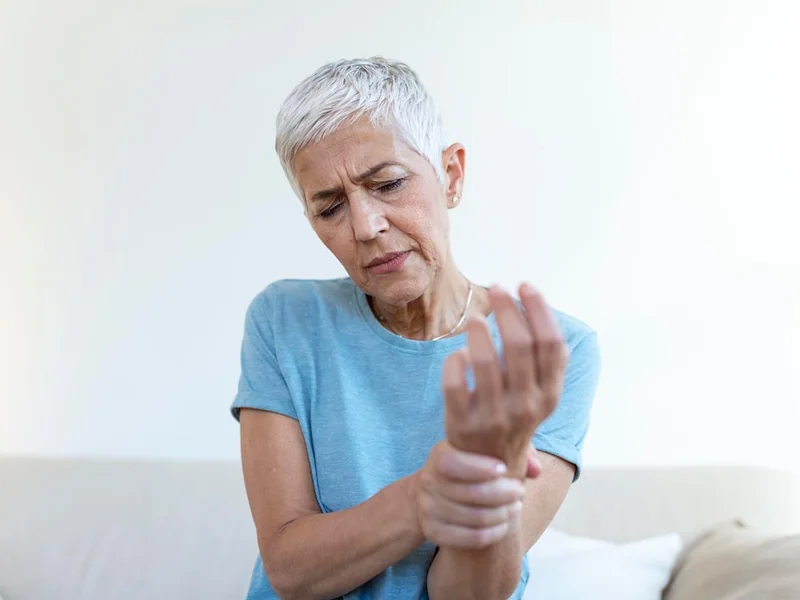
Small joints in the wrist and hand stiffen quietly, and grip is usually where you notice it.
Joint Pain
Not sure whether stiffness is your main problem? Start with an evaluation instead of a technique.

Sports Injuries
Range lost after an injury is the most common reason a return to sport stalls.