
Rotator Cuff Tears Treatment in Lake Forest
The arm still works, right up until you lift it over your head or roll onto it at two in the morning. You have been calling it a bad shoulder for months and quietly editing your life around it, which is a lot of effort to spend on something nobody has actually looked at yet.
What causes rotator cuff tears?
A rotator cuff tear is rarely one dramatic event. Far more often the tendon frays quietly over years, loses its tolerance for load, and gives way during something ordinary: a suitcase into an overhead bin, a dog pulling on the lead. Tears also come in degrees: a partial thickness tear leaves most of the tendon intact, a full thickness tear goes all the way through. What shapes your plan is not only the size of the tear but how much strength and control the rest of the shoulder still has.
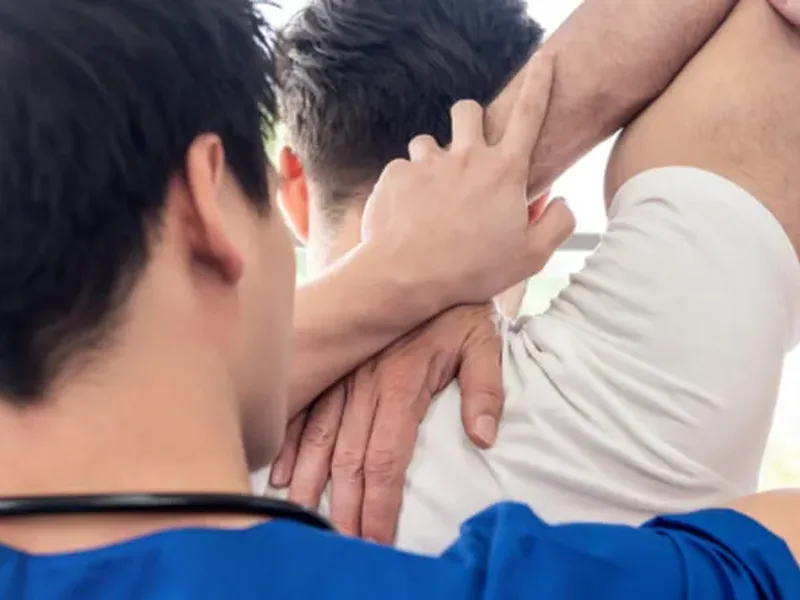
Tendons change with age. They become less elastic, the blood supply to the part of the cuff that tears most often thins out, and the tissue recovers more slowly. This is why so many cuff tears appear in people who never had a single injury to point to, and why plenty of tears show up on scans in shoulders that do not hurt at all. Wear on its own is not the story. Wear plus a shoulder that has lost strength and control is.
A fall onto an outstretched arm, catching yourself hard on a rail, a heavy lift, a dislocation. Acute tears usually announce themselves: sharp pain at the time, immediate weakness lifting the arm out to the side, and a night that is worse than the day. If your arm went weak suddenly rather than gradually, that is worth an in person exam soon rather than a few more weeks of waiting.
Painters, swimmers, tennis players and anyone who racks weight overhead ask the cuff for the same demanding pattern over and over. Tendons adapt to load, but only with enough recovery between doses. Take the recovery away and the tissue breaks down faster than it rebuilds. The fix is almost never to stop entirely, but to change the dose, restore the mechanics and rebuild the tendon's tolerance.
If the arm bone rides high in the socket, the cuff tendon gets compressed against the bone above it every time you reach. Years of that compression frays the tendon from the outside in. This is one of the few causes you can get ahead of, because joint position is changeable. Restoring shoulder blade motion and retraining the cuff to hold the arm bone down and centred takes the grinding out of the movement.
The cuff is small, and was never meant to carry a movement on its own. The shoulder blade should rotate and tilt underneath the arm so the cuff works in a good position throughout the reach. When the mid back stiffens and the muscles around the blade go quiet, that support disappears and the cuff absorbs the difference. Treating the tear without addressing the blade is how people end up back in the same place later.
A strain that settled on its own, a dislocation, a partial tear that quietened down enough to ignore. Pain going away is not the same as strength coming back. The shoulder learns to move around the weak spot, and the compensations feel normal until something bigger is asked of it. A great deal of what we see is not a new injury at all. It is an old one that was never finished properly.

How physical therapy in Lake Forest helps.
Many partial thickness tears do well with structured rehabilitation and never need an operation, because a cuff that is torn but well supported can still do its job. A hands-on exam tells us which tendon is involved and how much strength has gone, though only imaging ordered by a physician can confirm the size of a tear. If your shoulder is heading for surgery, the strength you build beforehand is what you recover into afterward. We handle both sides of that. Illinois is a direct access state, so most people can start without a physician referral. We verify your specific insurance benefits ahead of the first visit and tell you what you would owe. Self-pay is available. Your session is one to one, and the person who evaluates you is the person who treats you.
What to expect from your recovery.
Evaluation
We test each cuff muscle in the position that isolates it, so we can see which tendon has lost strength and how much. We measure your active range and your range when the arm is moved for you, watch the shoulder blade, and check your history for the pattern that suggests an acute tear. If your findings warrant a physician's opinion or imaging, we say so plainly.
Hands-on plan
Early work calms an angry tendon and restores the motion around it. Manual therapy and soft tissue release through the cuff, the shoulder blade and the mid back give the joint room to work. We sort out sleeping position and the reaches that keep provoking it, because what happens between visits matters as much as what happens in them.
Progressive loading
Then the tendon gets loaded, carefully and in steps. We rebuild the cuff and the muscles that steer the shoulder blade, starting below shoulder height and working up as your strength allows. We re-test the measurements from your evaluation as we go, so both of us can see whether the plan is working. If it is not moving, we change it.
Pain going away is not the same as strength coming back, and a great deal of what we see is not a new injury at all, but an old one that was never finished properly.
Pain rarely travels alone.
Elbow, Wrist & Hand Pain
A cuff that cannot hold the arm steady sends the work further down the limb. The elbow and wrist usually complain next.

Joint Pain
Stiff, sore joints that narrow what you attempt. We restore the mechanics first, then build the strength that protects them.

Sports Injuries
Throwing, serving and overhead lifting are where cuffs get found out. Returning safely means loading the tendon, not resting it.