
Neck Pain Treatment in Lake Forest
You have started turning your whole body instead of just your head, and you check the mirror twice because looking over that shoulder is not worth it. The workaround arrived so gradually that it stopped feeling like a problem.
What causes neck pain?
Your neck holds your head up all day while still letting you turn, tilt and look up. That mix of mobility and constant load is why it irritates easily and settles slowly on its own. Neck pain also travels. Left alone it becomes headaches at the base of the skull, tension across the upper back, and pain that runs down into the arm. Working out which structure is complaining is what changes the outcome.

The further your head drifts forward of your shoulders, the harder the muscles at the back of your neck have to work simply to hold it there. Sustain that through a working day and those muscles fatigue, the joints at the base of the skull stiffen, and the deep stabilizers that should do the quiet work switch off. Nothing tears. You just notice your neck aches by mid afternoon, every day. Changing the position, the desk setup and how often you get up is where relief starts.
A night asleep in a bad position, a heavy bag carried on one shoulder, a jolt in the car, a fast turn to catch something falling. Neck muscles are small and overload quickly. What follows is a protective spasm that limits rotation to one side and makes every head movement feel guarded. Most strains settle well, but only if the joint underneath gets moving again rather than being held rigid. Rest alone leaves a stiff, tentative neck behind.
Between each vertebra sit small paired joints that guide rotation and side bending. Age, old injuries and years in one dominant position thicken and stiffen them. The result is a neck that turns further one way than the other, grinds a little, and hurts most in the morning or after sitting still. Arthritic change on a scan is common and is not a verdict. Hands-on joint mobilization paired with movement the joint tolerates restores more range than most people expect.
When a disc bulges or the space a nerve root passes through narrows, the symptom often appears somewhere other than the neck: a line of pain down the shoulder blade or arm, pins and needles in the hand, or a grip that has quietly weakened. That pattern earns a neurological screen rather than a guess. If the exam points toward something that needs a physician's input, we say so. When it does not, nerve mobility work, positional relief and targeted strengthening usually settle it.
Stress does not stay abstract. It lands in the upper trapezius, along the jaw and at the base of the skull, and often stays long after the week that caused it. People are often surprised their neck pain is a load problem rather than an injury. Bodywork releases the held tension, breathing and postural retraining stop it reloading, and the recovery side of the studio exists partly for this: massage therapy, infrared sauna and red light give the nervous system somewhere to downshift.
A pillow that is too high, too flat or too soft holds your neck at an angle for hours. Stomach sleeping is hardest, because it forces the head into full rotation all night. Sleeping on your back with support under the natural curve, or on your side with the pillow filling the gap out to your shoulder, keeps things neutral. It is often the cheapest and fastest change we make.
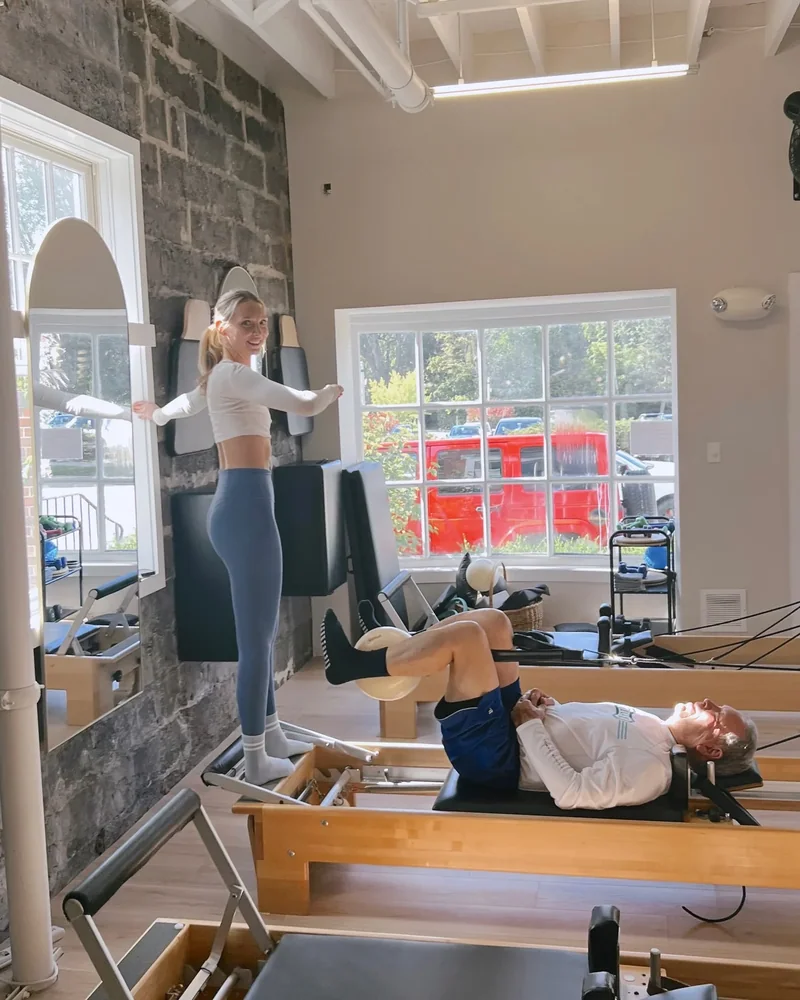
How physical therapy in Lake Forest helps.
Necks respond unusually well to hands-on care, which is fortunate, because it is the one area people are most reluctant to have touched. We begin with a proper evaluation: how far the neck turns and where the motion stops, how the joints move under a therapist's hands, whether the nerve is involved, how your shoulder blades and upper back contribute, and how the deep neck muscles hold up under load. The work is then manual therapy and soft tissue release to get the movement back, then postural retraining and strengthening so the movement stays. Massage therapy often runs alongside when held tension is a major driver. Illinois is a direct access state, so most people can start without a physician referral, and we verify your insurance benefits before your first visit so the cost is not a surprise. Your session is one to one from start to finish.
What to expect from your recovery.
Evaluation
We measure how far your neck moves in each direction and where the motion stops. We assess the joints by hand, screen the nerves if your symptoms travel into the arm, and look at how your posture and shoulder blades load the neck. You leave with an explanation and a plan, not a printout.
Hands-on plan
Joint mobilization and soft tissue work through the neck, upper back and shoulders restore the motion and quiet the guarding. We add gentle range of motion work you can do at home, plus the desk and pillow changes that stop you undoing the session every night.
Progressive loading
Once the pain is manageable we build the deep neck flexors, the mid back and the muscles that hold your shoulder blades in place. A neck strong enough for your day stops flaring. This is where we re-test the baselines from your evaluation, so progress is measured instead of assumed.
Most neck strains settle well, but only if the joint underneath gets moving again rather than being held rigid while it heals.
Pain rarely travels alone.

Elbow, Wrist & Hand Pain
Numbness and grip weakness in the hand often begin at the neck. We test the whole nerve path before treating the far end of it.

Joint Pain
Stiffness anywhere in the chain changes how hard the neck has to work. We restore the mechanics first, then build strength around them.

Sports Injuries
Contact, collisions and overhead sport all load the neck. Getting back safely takes range and strength, not just a quiet week off.