
Active Release Technique in Lake Forest
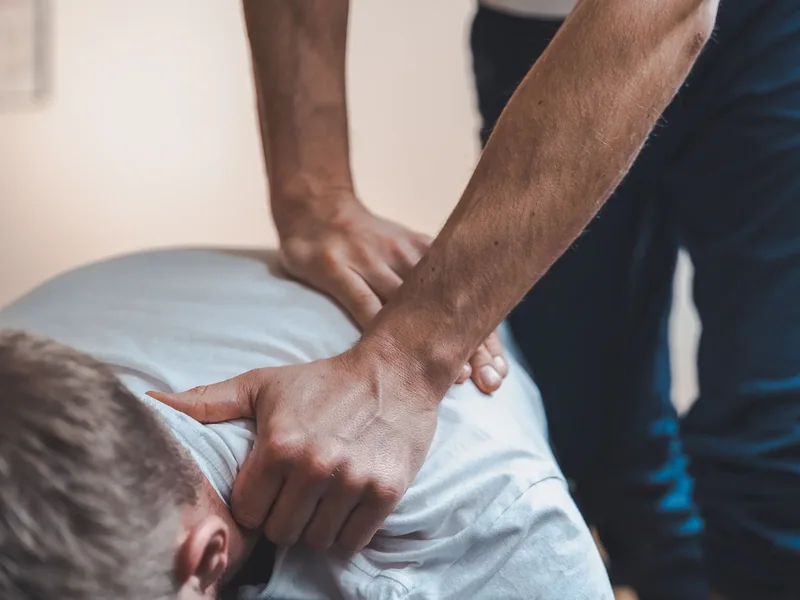
Some restrictions only show themselves when the tissue has to slide. Your therapist holds the tension while you move through range, so the stuck layer has to let go.
What is Active Release Technique?
You know the feeling: a pull at one particular point in the swing, a catch when you reach behind you, a tightness that is fine at rest and awful at the end of the range. Restrictions like that hide from a still exam, because they only show up when the tissue has to slide. Active Release Technique is built around exactly that fact. Your therapist places a hand on the tissue and holds a specific tension there, then guides you through a precise movement while that tension stays on. The tissue is drawn underneath the contact, and whatever is stopping it moving freely, adhesion between two layers, scarring between a muscle and its neighbour, or the point where a nerve is being gripped by the passage it travels through, has to shear apart for the motion to finish. Movement is not the warm-up here. Movement is the treatment. That is the honest difference between this and either massage or static stretching, both of which leave the layers stacked where they were.
Adhesions get laid down in fairly predictable ways: an acute tear that healed with scar in it, an overuse pattern that trained the same tissue through the same groove thousands of times, or long hours in one posture with the same structures held short. Whatever laid it down, the outcome is the same, tissue that no longer glides on its neighbour and a body that quietly borrows range from somewhere else to make up the shortfall. That borrowed range is usually where the pain turns up. This work is one part of a licensed physical therapy plan of care here rather than a standalone service, which means the release is followed by the strength and movement work that keeps it. Illinois is a direct access state, so most people can begin without a physician referral, and we verify your specific insurance benefits before your first visit so the cost is never the surprise.
Who it's for.
This technique earns its place when one specific tissue has stopped sliding and the problem only appears once you move. These are the patterns it fits best.
Overuse and repetitive strain
Tennis elbow, runner's knee, a shoulder that only complains overhead, a low back that seizes on the same lift. Repeated load lays adhesion down in the same place every time. Restoring the glide while the limb moves means the tissue stops being loaded through a bad angle, which is what let it build up.
Scar tissue after injury or surgery
Healed tissue is rarely tissue that moves well. Where scar has bonded layers that are meant to slide past each other, guided tension works that bond apart a little at a time, and the range you lost quietly during recovery starts coming back where you actually use it.
Nerve symptoms from a tight passage
Not all tingling comes from the spine. A nerve squeezed by tight tissue anywhere along its route gives the same signal. Freeing the tissue around that passage is often what quiets it, and you tend to notice the change first in the position that used to set it off.
What to expect at our Lake Forest studio.
Expect to work. You are not lying still while something is done to you, because the movement you make is the reason any of it works.
Finding the restriction by hand
Your therapist palpates along the muscle and tendon while you take the joint through its range, feeling for the point where the texture changes and the glide stops. Restrictions have a distinct feel under the hand. Nothing gets treated until it has been found, because pressure applied an inch away from the problem does nothing at all.
Tension plus motion
Contact goes onto the restriction, tension is set, and you take the limb through a specific path while that contact holds. It is a strong sensation and it is short. Your therapist works the same passage a handful of times, re-checking after each one, and stops when the tissue starts moving freely rather than pushing on for the sake of it.
Load it before you leave
Newly freed tissue needs a reason to stay free. You finish with the strength and mobility work that uses the range you just got back, plus a short home plan you can actually keep. This part is not optional, and it is the part people skip when they chase the release on its own and wonder why it keeps returning.
This work has bite. Firm pressure on a restriction while you move it is uncomfortable in the moment, and mild soreness afterwards, closer to the feeling after a hard set than to injury, is normal. It should stay mild and it should settle. Tell your therapist how the last session felt when you come back in, because that feedback sets the pressure for the next one. Discomfort is not the goal, and nothing here has to be forced to be effective.
Restrictions like that hide from a still exam, because they only show up when the tissue has to slide.
Where to go next.

Manual Therapy
Joint mobilization and hands-on soft tissue work for the restrictions that do not need a movement component to reach.

Sports Rehab
Sport-specific rebuilding once the tissue is moving again, loaded back up to the demands of your actual season.
Back Pain & Sciatica
Hip and low back tissue is common territory for this technique. Here is how we work through the whole picture.